

Each year, the National Fair Housing Alliance (NFHA) issues a report based on its collection of housing discrimination data from across the United States in the prior year. NFHA is the only national organization dedicated solely to ending all forms of housing discrimination and serves as the trade association for fair housing organizations throughout the country. Earlier this month, the 2025 Fair Housing Trends Report was released, highlighting the past year’s patterns, trends, and challenges. The Fair Housing Center for Rights & Research is a current member of the National Fair Housing Alliance and contributor to the annual report.
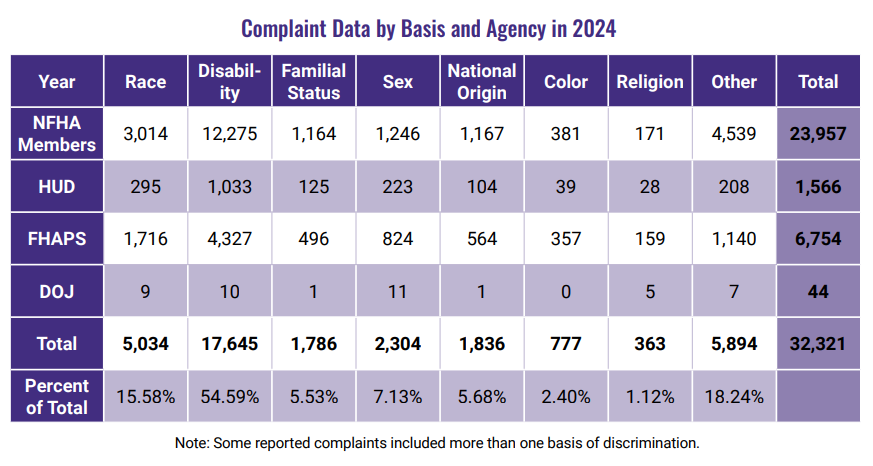
Last year, private, nonprofit fair housing organizations and government agencies that receive and investigate fair housing complaints received 32,321 complaints of housing discrimination. While this is one of the highest figures in more than two decades, the data collected represents only a fraction of the many incidents of illegal housing discrimination occurring yearly. Many cases go unreported because victims find it hard to prove discrimination or fear that reporting will lead to retaliation. Cuts to key federal fair housing funding has constrained the capacity of fair housing organizations, legal services, and government agencies. The report notes that the disruption and reduction in support and funding for fair housing activities has led to the closing of several fair housing organizations and caused some agencies to reduce services in the communities they serve.
Housing Discrimination Complaints
Despite a reduction in funding, private, non-profit fair housing organizations, like the Fair Housing Center for Rights & Research, continue to lead the way in processing complaints. Private, nonprofit fair housing organizations processed 74.12% of complaints, compared to 20.90% by Fair Housing Assistance Program (FHAP) agencies, 4.85% by the Department of Housing and Urban Development and 0.14% by the Department of Justice.
Of the 32,321 fair housing complaints filed, more than half of those reported complaints were based on disability. Year after year, disability-related discrimination makes up the majority of complaints, with last year accounting for 54.6% of all filings. Other leading bases of discrimination included race (15.58%), sex (7.13%), and national origin (5.68%). Complaints based on national origin increased by 8.45% from 2023, marking the highest number since 2018.
In 2024, complaints based on retaliation more than doubled, increasing from 234 complaints in 2023 to 472 complaints in 2024. The report highlights that the need for fair housing is still urgent. Everyone deserves a place to live without discrimination, and where we live should not limit our opportunities.
Case Highlight: Source of Income Protections
Data collected for the trends report is primarily on the seven federally protected classes: race, color, religion, national origin, sex, disability, and familial status. However, the report also includes additional data on classes protected under state and local laws, such as source of income. Source of income discrimination occurs when housing providers refuse to rent to a tenant based on their lawful source of income, such as housing vouchers, disability benefits, child/spousal support, or other non-wage income. In 2024, private fair housing organizations received 2,189 complaints of source of income discrimination.
The report highlights Fair Housing Justice Center, Inc. v. Parkchester Preservation Management LLC, where the Fair Housing Justice Center (FHJC) and the New York City Commission on Human Rights reached a landmark settlement of $1,050,000. This settlement is likely the largest monetary settlement ever for a case involving source of income discrimination. The FHJC and the Commission alleged that Parkchester Preservation Management LLC and PPC Residential LLC (collectively “Parkchester”) set income requirements that unfairly excluded people who use housing subsidies like vouchers. The policy and practice go against New York City’s fair housing laws prohibiting source of income discrimination. The complaint was based on a year-long FHJC testing investigation which revealed that the respondents maintained and enforced an income requirement for rental applicants, which excluded renters with housing subsidies that pay part or all of their rent.
As part of the settlement agreement, Parkchester will now accept all types of rental assistance. They will not apply credit history, employment, or housing history requirements to applicants using rental assistance, and will modify application forms and application processes to comply with fair housing laws. A victory for source of income protections.
The Fight for Fair Housing Continues
Many Americans are facing a serious housing crisis that affects their daily lives. Where we live impacts our access to essential services like clean air, good schools, healthcare, and jobs. High housing costs and a lack of affordable options are significant issues, contributing to rising inflation. By December 2024, housing costs were the largest factor in overall inflation increases.
Recent federal actions have not offered solutions to these problems. The data and insights from the 2025 Fair Housing Trends Report highlight the urgency of addressing housing discrimination across the nation. The report emphasizes the need for sustained resources, effective enforcement, and innovative strategies to fulfill the promise of the Fair Housing Act. The fight for fair housing is far from over. The ongoing challenges highlighted in this report call for a collective effort from individuals, organizations, and government agencies to ensure that everyone has access to safe and affordable housing.